A lichen is a symbiotic community made up of multiple organisms. By coming together and supporting each other, they are each able to thrive in a way that they couldn't alone.
The goal of this system is to create a space where DJs, dancers, artists and musicians can work together to create unforgettable experiences.
Against the backdrop of private equity buying music festivals, AI generating songs, and Instagram follower counts determining bookings, the goal is to create an ecosystem where art and community can thrive not just survive.
Now let's get specific
The System
The system is designed, both visually and acoustically, to blend in harmoniously with nature around it.
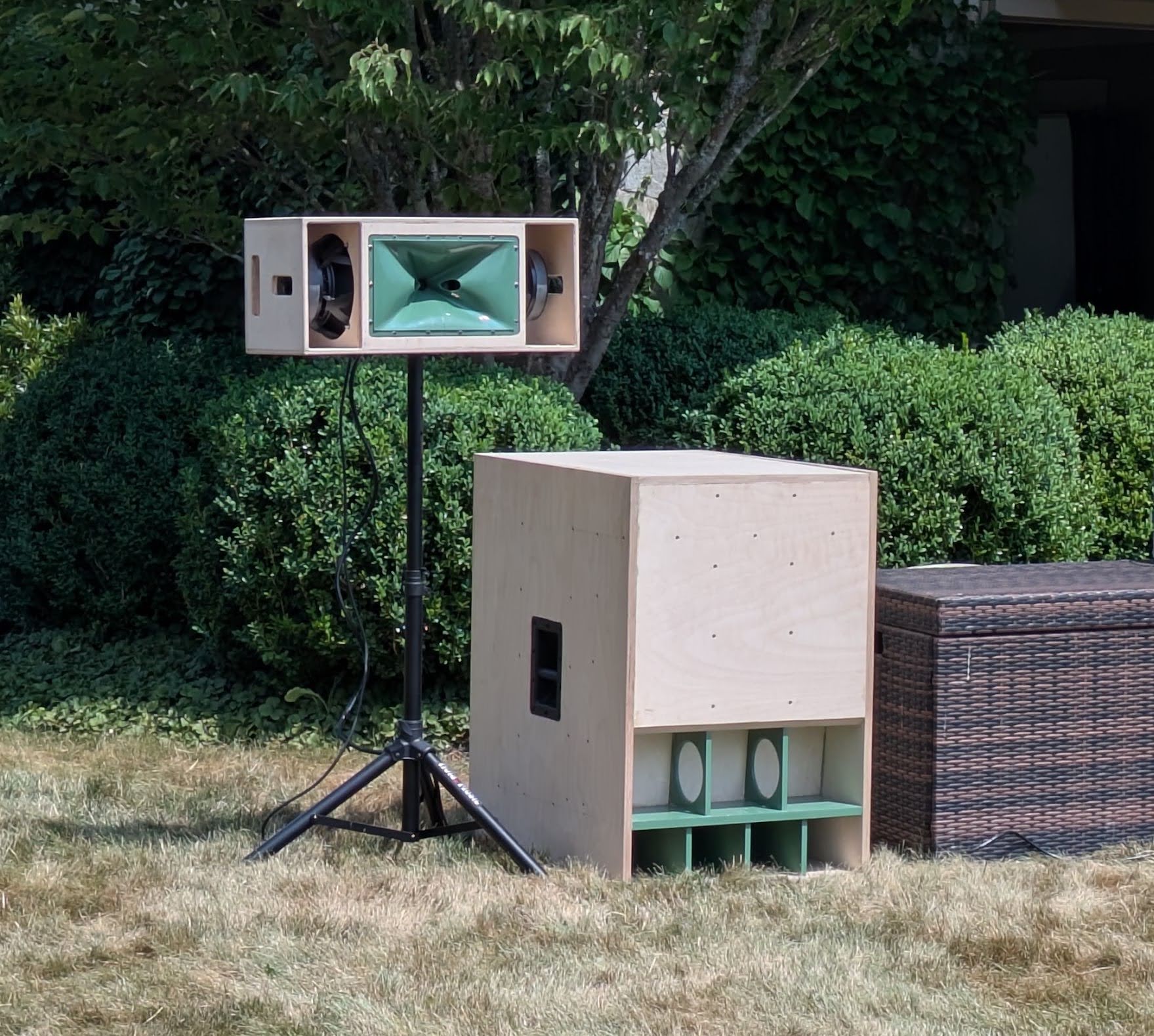
Visually, it belongs in a forest clearing, a barn, or an old mill. The cabinets are finished in natural birch with moss green accents.
Acoustically, it was designed for bass music with visceral sub frequencies and accurate high-end which excels on anything crispy, froggy, or wet. As it turns out, the system also sounds good playing everything from techno to bluegrass.
Design goals
HiFi sound that is pleasant, not just loud
Cutting edge acoustics combined with traditional craft construction
Open-Source designs and knowledge sharing
Modular system for large and small events
Source
DSP
Amplification
Speakers
Low end · 29Hz-115Hz
SKRAM Subwoofer
Drivers
1x 21"
Enclosure
6th order bandpass, birch ply
Frequency range
29 Hz – 115 Hz
Power handling
2000W RMS | 4000W Peak
Weight
170 lbs
Design goals
29Hz sub-bass for Dub genres
Powerful high-extension - no need for kick bins
Even frequency response
The SKRAM design by Josh Ricci (data-bass.com) provides heavyweight sub-bass and even mid-bass extension in a single box. At 450 liters and 170lbs it's not small by mobile DJ standards, but it punches above its weight. Tuned to 29Hz, the SKRAM hits the lowest notes of Dubstep tracks with authority. With the dual-chamber design, it is also able to provide punchy kicks, eliminating the need for separate kick bins.
Mids + highs · 115Hz-20kHz
2x SAWMOD Tops
Drivers
2x10" low + 2x5" mid + 1" compression driver
Enclosure
3-way Multiple-Entry Horn
Frequency range
115 Hz – 20 kHz
Power Handling
1300W RMS | 2600W Peak
Weight
46 lbs
Coverage
110°H × 70°V
Design goals
Single acoustic center - true point-source experience
Constant directivity for even coverage
Tight kicks with low group-delay
Small enough to pole-mount
The SAWMOD design by John White (jwsound.live) uses a 3d-printed multiple-entry horn design which has been optimized to provide even coverage for everyone on the dance floor. The result is that these sound like HiFi speakers but hit concert volumes.
Power · placeholder
Amplification
Class
D
Channels
8
Power
2x5000W, 4x1500W, 2x140W
Design goals
Modern Class D Amplification
Efficient for battery/generator usage
Lightweight for portability
The system includes >16KW of modern Class D amplification. These amps are more efficient than older topologies, providing clean, accurate sound with power to spare.
Crossover, EQ, limiting
Processing
Crossovers
active
Limiting
per-driver peak + thermal
EQ
per-driver and system
Delay
per-driver
Inputs
Digital (AES) or analog (XLR)
Design goals
Flexible system configuration
Coherent phase alignment of all drivers
The system uses a DSP to implement active crossovers, accurate time alignment, room correction, and more.
Tech rider
What comes with the system.
Typical coverage: 300 people indoors, 200 outdoors (102 dBA LEQ1).
Provided by Little Lichen Sound
1× SKRAM 21″ bandpass subwoofer (4 available for summer 2027)
2× SAWMOD 3-way horn-loaded tops
8ft tripod stands for SAWMODs
16 kW Class D amplification
DSP for system tuning and integration
Generator for off-grid deployments
SoundCraft Signature 12 Mixer
Placeholder: DJ booth monitor
Provided by the organizer / venue
DJ mixer with XLR (analog) or AES (digital) output
CDJs / turntables
Microphones, if needed
Sturdy table for the booth
Power within 50 ft of the stage (unless using the generator)
I caught wind of this event and immediately knew I wanted to be there. Dancing in the woods, in Maine, in October, and raising money for Out Maine? This was bound to be a cool group of people. Aly (DJ Goldey) kindly entrusted me with sound duties and after a drive through the fall foliage and a tractor ride into the woods I found myself in a bedazzled forest clearing.
The SAWMODs were deployed high and wide to cover the clearing, fire pit, and some of the surrounding woods. The SKRAM went right next to the stage among the fallen leaves. The sound filled the clearing quite well! So well in fact that we received a noise complaint and had to turn the system down a bit towards the end of the night. The SAWMODs were barely working all night with 12+dB to spare. The SKRAM never hit a limiter, but was a lot closer around 2dB during drops. That's good news because it definitely justifies building more subs over the winter - right??
The DJs and musicians for this were awesome - Sergio kicked off with a set of latin music with some catchy house and disco cuts thrown in. Clio playing her electric harp and sang some beautiful tracks off her new album (first live performance on the system!). DJ Goldey laid down a grooving set alternating between catchy fresh remixes and tight, punchy drops. Finally TUMBLDOWN closed out the night with a marathon 3 hour improvised set, keeping the dancefloor packed despite temps dropping to 37 degrees!
Needless to say this one was a real gem and I already can't wait until next year.
It was my first time at As Above So Below, and also the first deployment with the system so I didn't quite know what to expect. There were quite a few renegade soundsystems at the event, so I opted to join forces with Chips N Dip soundsystem.
The SAWMODs were deployed as booth monitors and the SKRAM was deployed front-and-center on the Chips N Dip stacks.
I was very happy with how it went! DJs noted how crisp and clean the SAWMODs sounded, and the SKRAM sub-bass really complimented the powerful kicks of the Chips N Dip rig.
As a 16 year old I went to my first Dubstep show and was immediately hooked on the feeling of chest-shaking bass. In one way or another I've been chasing that feeling ever since.
I started my sound journey as a mobile DJ playing parties and weddings. It was supposed to be a way to make money but I ended up spending just about all of my earnings on new gear - no regrets there.
I went to college for computer engineering and took classes in music recording, acoustics, and signal processing finally learning the theory behind the hands-on work I had been doing for years. From there I got a job writing audio software for speech processing.
I decided to build Little Lichen Sound as a way to combine theory and engineering with the satisfying hands-on work of woodworking. It's also been a great way to engage deeper with the local electronic music community.